
Author: Camille Dungy
-
Guidebook to Relative Strangers featured in the Birmingham Times for Women’s History Month
“Her work is part travel diary, part maternal memoir, and part self-discovery. As a poet, Dungy’s writing skitters across the page, shining daily scenes of motherhood and surroundings through an intersectional lens. A MUST READ.”
Read more here
-
Book Recommendations: Robert Hass and Czeslaw Milosz
Today’s book recommendations are a strike against social isolation. This week I found myself reading my way into community by exploring the new book, Summer Snow, by former Poet Laureate Robert Hass alongside an older collection, Unattainable Earth, by the inimitable Czeslaw Milosz.•Hass worked with Milosz to translate many of the poems in Unattainable Earth, and so that is one way I see community and communion at play in these collections. The long, stunning poem by Hass (from Summer Snow), is an imagining of a conversation between the two poets. I love thinking about how writers think about each other’s lives and minds.•Milosz himself made a point of creating such communion in Unattainable Earth. In the original Polish version of the book, Milosz translated English-language poems into Polish. In the American version of the book, in which Milosz’s own work is what we receive in translation, Milosz’s poems sit alongside English-language masterpieces by poets such as D. H. Lawrence and Walt Whitman.•Just because we’re staying at home doesn’t mean we can’t hang out together. I am grateful to Hass and Milosz for these examples of what happens when poets talk, think, translate, share, and imagine a world together, across continents and centuries and collections. -
Camille contributes to the “The Quarantine Files” for the Los Angeles Review of Books
“Last winter, I hardly left the house because it was dangerously cold outside. Sheets of thin ice covered walkways. People — worried about landing in the hospital — hardly socialized for months. There was the winter I fretted about friends and family suffering from conditions over which they and their medical teams had little control. That was the same winter my concerns flared for friends who were foreign nationals. Would my country — whose leadership had proven hostile on countless occasions — directly or indirectly take actions that might cause my friends harm? There was the winter I mourned the direction my nation had taken the past fall. The policies of the new government — and those backing the new government — no longer seemed to have the best interest of the majority of people in mind.”
-
Book Recommendation: The Grammar of God
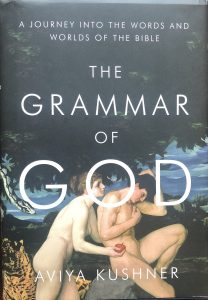
I can’t stop thinking about The Grammar of God by Aviya Kushner. The book is on my mind because of the many narratives running right now in public discourse. Narratives that suggest some of us aren’t speaking the same language as others where C-19 is involved. Kushner’s book suggests that often we AREN’T speaking the same language. That we haven’t been consulting the same playbook, even when we might have thought we were. Though Kushner’s book isn’t about C-19, reading The Grammar of God may help you understand how our public discourse has gotten to this point.
Due to variations in translation, the Bible, the text on which we base so many of our culture’s religious and secular principles, often contains drastically different messages as it moves through languages, grammars, and cultures. For many of us who think carefully about language and how we use it, this shouldn’t be a surprising concept. But The Grammar of God is so carefully researched and grippingly told that I love reading Kushner’s explications and revelations.
After spending a lifetime diligently studying the Hebrew Bible, Kushner first read the Bible in English when she was 28. I love her descriptions of her shock on encountering some of the differences between the Hebrew and English Bibles. She becomes obsessed by these questions, consulting many translations, researching the lives of translators through time, considering what the differences in meaning and interpretation might reveal. This could all be esoteric, sleep-inducing stuff, but in Kushner’s skilled hands the research and analysis becomes the base material for a page-turning, emotionally-resonant book. The ways she weaves her personal experiences alongside those of her own family and of Biblical and linguistic scholars through time is nothing short or mesmerizing. (The story she tells of her grandfather toward the end of the book brought me to tears.)
You can get The Grammar of God most easily via ebook, so it might be the perfect book to buy if you’re avoiding deliveries because you’re worried about the virus.
-
Book recommendations is back! Minor Feelings
I’ve been away from sharing what I’m reading for what seems like a long time. But now I’m back, with #bookrecommendations!
•
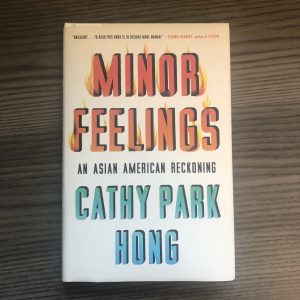
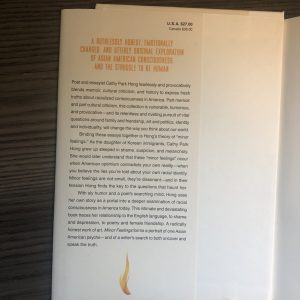
I have major feelings—It’s so good! So smart and powerful! So beautifully written! So necessary! So insightful! Breathtaking!—about this phenomenal book, Minor Feelings by Cathy Park Hong (One World Books: 2020).
•
It arrived at my doorstep at the very beginning of our state’s stay at home orders. Were I not the mother of a young child I am suddenly now homeschooling, I would have read the book in one complete sitting. Instead, I spread the reading over 3 ravenous days. These pages burn with the fire of truth and necessary revelation. Cathy Park Hong understands America in the way Baldwin understands America, with the observant eye of a scorned but needed, even sometimes loved, child. Perhaps you know that feeling, when the world around you says everything is hunky dory, and you think, So why do I feel so dissonant today, like this isn’t all going as well as everyone else seems to think? Those are the minor feelings of which the book’s title speaks.
•
The subtitle of this collection is “An Asian American Reckoning” and much of Minor Feelings speaks specifically to an Asian American experience (I am careful here not to write THE Asian American experience) that is not mine and which I am grateful to learn more about. But for much of the book I was nodding along. Yes! Yes! Yes! I see you! And not only because I have lived many of the places and experiences the author has lived. Even when our lives do not overlap, she has drawn her world so well I cannot help but come to know it, feel it, see it. This is a work of honest, open wisdom. I am grateful to have the memory of reading Minor Feelings during these isolated, generally dissonant, times.
-
Camille included on Mashable’s “6 inspiring poets you should read year-round, not just during Black History Month” List!
“Dungy’s poetry often incorporates themes concerning the natural world, giving an urgency to the hope imbued in her poems.”
Find the list here.
-
Camille’s poem “From the Unwritten Letters of Joseph Freeman (February, 1841)” is featured on The Gleaner
“The poems below, however, are not all heartbreak poems although Camille Dungy’s poem, written in the voice of a former freeman now slave, is a beautifully sad reminder that Valentine’s Day is almost smack in the middle of Black History month.”
Read the poem here.
-
Camille is one of the featured Climate Visionaries on the Greenpeace website
“As we begin this critical new year in the fight against climate change, Greenpeace is giving over space on our channels to authors and artists working within the climate crisis. Acclaimed author Lauren Groff prompted artists and thinkers to write essays and art about climate change for us, and so every day this month we’ll have a new piece from that project that addresses, in some form, what it means to create in the midst of this crisis. The forces fueling climate change have the most powerful networks in history pumping out their devastating propaganda at unimaginable scale. It’s going to take everything we have from all of us – imagination equal to the task – to create the climate we’ll need to stop the crisis.
[…]
We need these voices and these visions, but they won’t be enough. We need you, too. We encourage you to check back on the Climate Visionaries Artists’ Project every day to see what’s new, and to join the conversation by sharing your work on Twitter, Facebook, and Instagram and tagging it #ClimateVisionaries.”
Read more here.
-
Ten 2019 Book Recommendations for Holiday Giving
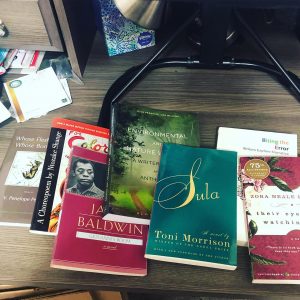
Many of you know I have been posting regular book recommendations on Instagram and Facebook. Here are some of my favorite reads from 2019 for those of you looking to buy books for yourself or others this holiday season. Here, also, are some photos of selected books in the spot where I last read them.
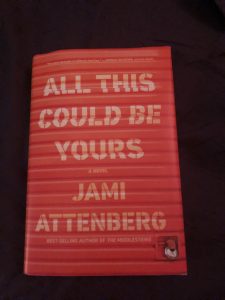
- All This Could Be Yours, Jami Attenberg (Houghton Mifflin Harcourt, 2019): This book is so good, friends! Equal parts disturbing and tender. If you can’t read the writing on the top of the image, it says, “The poet laureate of dysfunctional families—Kirkus Reviews.” This book is a deeply moving study of a desperately troubled family. It is also a straight up love letter to the City of New Orleans and its inhabitants. And it’s a fascinating example of the fun a novelist at the top of her game can have with voice and point of view.
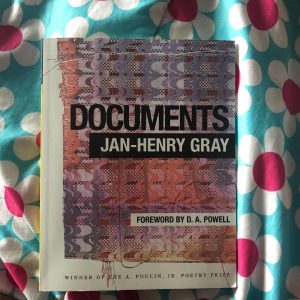
- Documents, Jan-Henry Gray (BOA editions, 2019): Documents is the poet’s debut book and, wow, what a way to head out of the gate! Some of the documents under scrutiny in this collection: those documents required to prove a legitimate claim on humanity, those required to prove a legitimate claim on the ability to love who you love, those required to prove a legitimate claim on your rights in the workplace, those required to prove a legitimate claim to any rights at all. Near the end of the collection the poet inserts an essay, the beginning of which is about the clearest explanation I’ve ever read of why I sometimes find myself needing to write/read one form rather than the other. By including this piece, Gray highlights his key constellation of questions: how best can we document our bodies/lives/loves/homes/ideas and what does it mean if sometimes/often such documents are hard won?
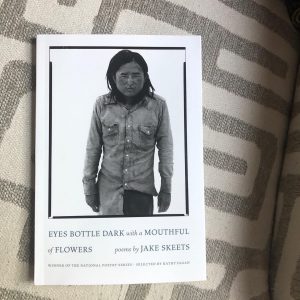
- Eyes Bottle Dark With a Mouthful of Flowers, Jake Skeets (Milkweed Editions, 2019): So much to love about this book. Skeets’s lyrics lay bare the splendor and terror of living and loving in the world he reveals, more so for a man-loving man, even more specifically for a Diné man trying to survive in Gallup (or what the book calls Drunktown). There is a great deal of brutal (and often seemingly routine) violence in this book, but there is also so so very much tenderness. This book took my breath away over and over again.
- Emergence Magazine Print Edition and Practice Booklet (emergencemagazine.org, 2019): Full disclosure, I have an essay in this collection, but you’ll also find work from U.S. Poet Laureate Joy Harjo, two Pulitzer Prize finalists, recipients of the American Book Award, the TED Prize, The Bookseller Book of the Year Award, the John Burroughs Medal for Outstanding Nature Writing, and the Sundance Film Festival Grand Jury Prize.”Our inaugural print edition is a collection of essays, poems, adapted multimedia stories, and photo essays from our first four online issues. Tactile and intimate, this edition spans 296 color-filled pages and eight different textures of paper—inviting you to slow down and enjoy these stories over time.” This is one of the most beautiful books I held in my hands in 2019.
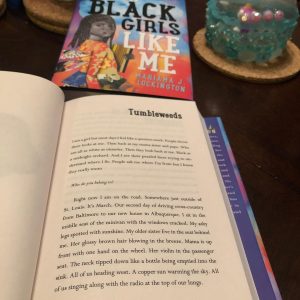
- For Black Girls Like Me, Mariama Lockington (FSG, 2019): Told through alternating forms including songs, spare and honest prose, letters, journal entries, and Tumblr posts, For Black Girls Like Me is the story of an 11-year-old black girl who is trying to figure out where she is going at the same time she is discovering where she might be from. Adopted into a white family and adjusting to a move thousands of miles away from her best friend, the only other black girl she knows, the main character must discover her own way of making a home. In addition to wise and beautifully spun thoughts about race, gender, and adoption, this book shares important insights on mental health, family, and what it means to live as and with a working artist. It’s a serious book, but it is also full of joy and empowerment. The book is targeted to Middle Grade readers, but I promise grownups will fall in love with it too.
- Holy Moly Carry Me, Erika Meitner (Boa Editions, 2018): In this book, Erika Meitner manages to talk about so many of the things that keep me up at night. Gun culture, police violence, disaster capitalism, intolerance, children and how hard it can be to have them and to keep them alive, generational trauma, generational triumph, the kooky places we live, and pubic hair after 40. This is just a small list of some of the many topics this book explores. I mean by this that Holy Moly Carry Me is serious, funny, thought-provoking, and fun.
- Silk Poems, Jen Bervin (Nightboat, 2017): This book is a stunning and fascinating document. Full of facts and force and fun and fancy, it taught me more about the silk worm, silk, language, history, life, the brain, science, art, and longing than I could think possible in such a slim volume. A fun gift idea for the weaver, knitter, writer, scientist, or history buff on your list.
- Sula, Toni Morrison (Knopf, 1976): Clearly this is not a new book, but it is a GREAT book. My favorite of all Morrison’s amazing novels. With the passing of this great American thinker this year, maybe it’s time to revisit some of her best work?
- Trespass: Ecotone Essayists Beyond the Boundaries of Place, Identity, and Feminism (Lookout Books, 2019): Among the twenty tasty essays in this book is my own, “Differentiation,” about the time I traveled to Barrow, Alaska, ate some delicious food, went looking for polar bears, and made a new friend. This anthology would be great for the explorers, boundary crossers, women, and women-lovers on your list!
- White Papers, Martha Collins (University of Pittsburg Press, 2012): Wondering how to dive into writing and thinking and being honest about the costs of white privilege? Get this book! In her stirring and honest long poem, Martha Collins makes clear the many ways oblivion to history and its daily repercussions is damaging to white people as well as black people. She says what is too often left unsaid, reveals what festers unacknowledged in so many corners, reminds us of forgotten truths and reiterates truths that for many of us have always been in plain sight. And the poem(s) do all this while sounding good and singing strongly and working the potential of the line and the page. (Also, the book has a handy reference section for further reading!)